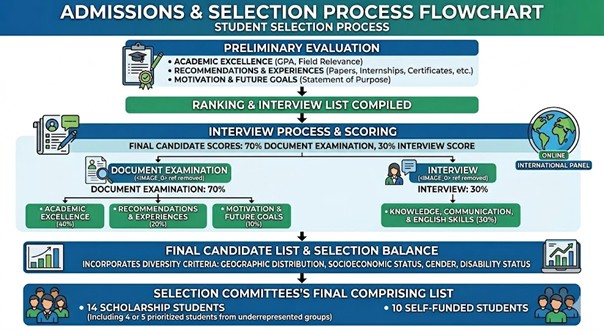
The selection process is conducted in two stages: primary assessment and interviews.
Preliminary evaluation and interview processes are conducted to evaluate applicants.
Academic Background and Scientific Competence
During preliminary evaluation, the following requirements are applied: bachelor’s degree in one of the following (or closely related) fields: bioengineering; biomedical engineering; material sciences; pharmaceutical sciences; biomedical sciences; genetics; molecular biology; biotechnology; medicine; dentistry; or similar.
Applicants are expected to possess scientific competence in fields such as:
• Cell and molecular biology
• Genetics and biotechnology (including molecular cloning, bioprocessing, and genetic engineering)
• Biomedical sciences (physiology, microbiology, immunology, pathology)
• Bioengineering and biomedical engineering (tissue engineering, biomaterials, biosensors)
• Materials science and engineering (polymers, ceramics, composites, surface modification)
• Chemistry (organic, inorganic, analytical, and physical chemistry)
• Physics (biophysics, thermodynamics, kinetics)
• Pharmaceutical sciences (drug discovery, drug delivery, pharmacokinetics)
• Related interdisciplinary areas
Preliminary Evaluation Criteria
The preliminary evaluation is based on each applicant’s:
• Academic excellence
• Recommendations and experiences
• Motivation and future goals statements
The candidates are ranked according to weighted scoring, and an interview list is compiled.
Interview Process
Interviews are conducted online by an international panel from the partner universities.
Candidates’ final scores are calculated by taking:
• 70% of the score from the document examination
• 30% of the interview score
Detailed Scoring Criteria
The criteria for determining the final scores are as follows:
• Academic excellence (GPA, field relevance): 40%
• Recommendations and experiences (papers, internships, certificates, etc.): 20%
• Motivation and future goals (Statement of Purpose): 10%
• Interview (Knowledge, communication, and English skills): 30%
Final Candidate List and Selection Balance
When preparing the final candidate lists, additional underrepresentation criteria such as geographic distribution, socioeconomic status, gender, and disability status are included.
The committee prepares a list comprising:
• 14 scholarship students — including 4 or 5 prioritized students from underrepresented groups
• 10 self-funded students